
Turn more conversations into better customer experiences.
Help customers get answers, capture new enquiries, and give your team more time for the calls that need them. Discover voice AI built around your business, your knowledge, and your customers’ language.
Meet the Epsilon team. Explore your use case. No account required to enquire.
Watch a scripted conversation unfold in Arabic dialects and English. This visual simulation uses sample information; no audio or live call is playing.
Enterprise AI by Epsilon since 2015 · Egypt · Saudi Arabia · USA
Explore support for routine customer questions.
Capture context for the next conversation.
Keep people focused on complex customer needs.
The problem
The calls don’t wait for you to have capacity.
Four pressures weigh on contact centres every day — and they are where the Epsilon team starts with you.
Queues build; too few calls resolve on their own.
Peaks overwhelm the team, and simple, repeatable questions still tie up an agent instead of being contained.
One “Arabic” setting doesn’t fit every caller.
A Cairo caller and a Riyadh caller don’t speak the same variety — generic voice AI leaves customers feeling misunderstood.
Nights, weekends and holidays go unanswered.
Enquiries arrive around the clock, but round-the-clock human staffing is expensive and hard to sustain.
Escalations reach your team with no context.
When a conversation needs a person, the customer repeats everything and the agent starts cold — losing time and goodwill.
Why it matters
Every conversation is a chance to earn trust.
When customers wait, repeat themselves, or cannot get help in their language, your business feels the impact. Start with the call types where better service can make a measurable difference.
Help customers move forward.
Explore clear, consistent answers for common enquiries, with a path to your team when a conversation needs personal attention.
Give each enquiry a next step.
Explore how an AI assistant could capture what a prospect needs and prepare useful context for your sales team.
Reduce repetitive conversations.
Identify routine call types that can be handled with approved information, so your people can concentrate on work that needs their expertise.
Built around your call types
Start with a use case your team knows well.
Bring a real business challenge to your demo. Epsilon will help you assess the workflow, required connections, and a sensible pilot scope.
Common questions & service guidance
Explore product information, service policies, branch details and routing to the right team.
New enquiries & lead qualification
Explore capturing a prospect’s needs and preparing a structured handoff to your sales team.
Help customers plan their next step
Assess availability enquiries, booking requests and reminders with the integrations your workflow needs.
Order enquiries & follow-up
Assess order-status conversations and consented follow-up connected to your approved business systems.
Use cases are examples to scope with Epsilon. Integration availability, outbound permissions and deployment requirements are confirmed for your project.
Language is part of the experience
Dialects, not just languages.
“Arabic” is not one setting. A Cairo caller and a Riyadh caller are not speaking the same variety, and the agent matches the dialect before it matches the language — so customers feel understood.
العربية المصرية
العربية السعودية
العربية الإماراتية
العربية الفصحى
English (UK)
English (US)
Français
اردو
हिन्दी
Türkçe
Español
Español
Deutsch
中文(普通话)
Português
Italiano
Русский
日本語
Live coverage today, with more dialects in evaluation. Ask the team to demonstrate your required dialect and confirm availability for your use case.
From first conversation to a clear plan
Start focused. Measure what matters.
Your demo is the beginning of a practical discussion about fit, value and what it takes to deploy responsibly.
Show us the calls that matter.
Share your goals, call types, languages and current challenges with the Epsilon team.
Explore the experience.
Review a guided demonstration and discuss the knowledge, systems and human handoff your use case needs.
Agree how success is measured.
Scope one workflow, set a baseline and agree the service, quality and commercial measures before expanding.
Your workflow. Your success criteria.
Leave the discussion with a clearer view of the opportunity and next steps.
One enterprise platform
Everything a voice call centre needs.
A complete enterprise voice agent platform. Start with what your pilot needs; switch on the rest in your deployment.
Human-natural voice, every dialect
Lifelike ElevenLabs speech, barge-in, live sentiment and per-agent persona — always identified as AI.
Inbound & outbound call centre
PSTN in and out, IVR and smart routing, skills-based queueing, warm transfer, callback and voicemail.
Grounded in your information
Answers only from approved content, with document ingestion and retrieval tuning.
Guardrails, audit & PII redaction
Two-stage guardrails, a tamper-evident trail, MFA/passkeys, data residency and recording policy.
Analytics, CSAT & QA
Real-time and historical analytics, satisfaction, automated quality scoring and call summaries.
CRM, webhooks & API
Read and write to your CRM and ticketing mid-call, with webhooks and a REST API.
Modules are switched on per workspace, so each client gets exactly the platform they need — and can add more without a migration.
Not every capability shown here is live out of the box — some are switched on or added during deployment, depending on the selected providers, integrations and implementation scope.
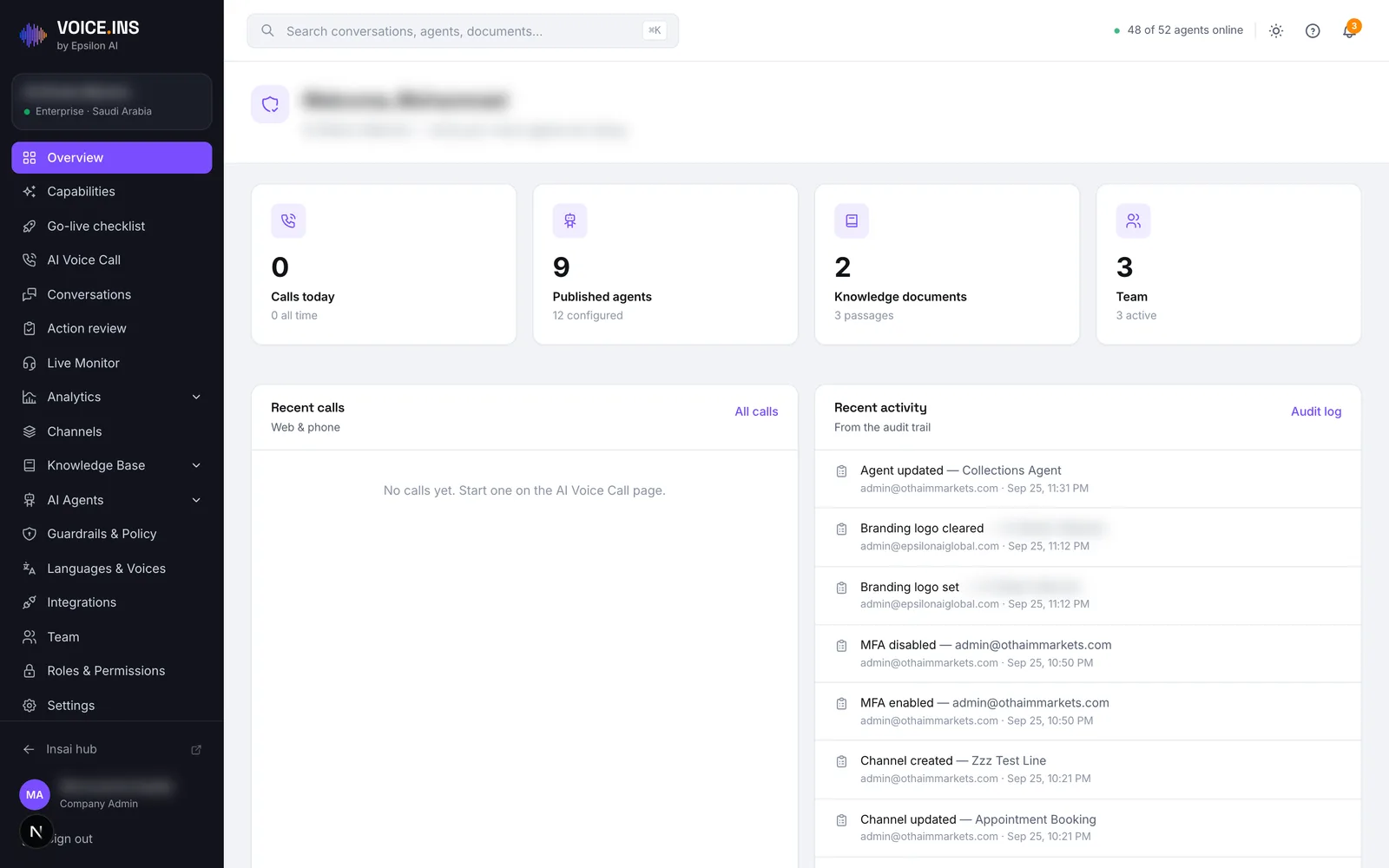
Product screenshots
See VoiceINS in action
A look at the console your team works in — from the daily overview to a live call in progress.
Signed client recognition
Organizations that put their recognition in writing.
Signed recognition letters from clients across Epsilon's delivery. They reflect the team's track record — not every organization is a deployment of this product.
Rowad Modern Engineering
Construction
Signed letter
Mogassam
Contact centre
Signed letter
Zylo3D
Manufacturing
Signed letter
NUT Botanicals
Retail & recommendations
Signed letter
AIT
Real-time data
Signed letter
Why Epsilon
Built by a team that has shipped production AI since 2015.
InsAI platforms run on the applied-AI engine Epsilon AI Global has built and delivered for a decade — across three markets, for enterprise and government teams.
Since 2015
a decade of applied AI
100+
enterprise & government clients
10,000+
professionals trained
3 markets
USA · Egypt · Saudi Arabia
These figures describe Epsilon's company-wide experience — not this product's own customer counts.
Cloud · On-premise · Hybrid
Deploy where your business needs it.
VoiceINS can be scoped for managed cloud, on-premises, or hybrid deployment. Your deployment plan defines where call audio, speech processing, AI models, business data, and recordings are processed and stored. Supported providers, data residency, capacity, security controls, and operating responsibilities are confirmed before launch.
Fully managed cloud
We run it end to end, isolated per company, with high availability and automated recovery — fastest to launch.
Inside your datacentre
Deploy within your own infrastructure for full data control — self-hosted speech and models keep every byte in your walls.
Best of both
Keep sensitive data and inference in your region or on-prem while the control plane runs in the cloud.
We do not promise that every byte stays on-premises if a selected component sends information to an external service. Capabilities marked “Add during deployment” are optional modules for project scoping — availability depends on the selected architecture, providers, integrations, and implementation scope.
Natural conversations. Clear boundaries.
Trust belongs in every call.
Ask how your proposed deployment will handle identity, approved information, permissions and escalation before it serves your customers.
Clearly identified as AI
Natural speech should make service easier. Customers should understand when they are speaking with an AI assistant.
Grounded in your information
Review how approved business knowledge and response policies will guide the agent’s answers.
A clear path to your team
Define when a conversation should reach a person and what context is appropriate to share.
Screened twice — before the model, and before it speaks.
Inbound checks read the caller before a model is reached at all; outbound checks read every reply before it is spoken aloud. Rules that exist for a contract or a regulator are locked on and cannot be quietly switched off.
Before the model reads the caller
- Prompt injectionLocked
- Out of scope
- Abuse and threatsLocked
- Distress and vulnerabilityLocked
Before a word is spoken
- False human identityLocked
- Unsourced figuresLocked
- Commitments and guaranteesLocked
- Regulated adviceLocked
- Personal data read-backLocked
- Competitor comparison
- Hedged speculation
Built for regulated, multi-tenant operations.
Every workspace is fully isolated — no tenant can see another’s calls, data or configuration.
Can I see a demo before committing to a project?
Request a guided demonstration with Epsilon. The team can discuss your use case and arrange access to a demo workspace using sample calls. Your enquiry does not create an account or start a subscription.
Can we use our existing phone system and business data?
Share the phone, CRM and knowledge systems you use. The team will assess the connection options and confirm which integrations your proposed deployment would require.
Can we test Arabic and English?
Include your required languages and dialects in your enquiry. Ask the team to demonstrate the relevant voice configuration and agree a test set for your pilot.
What happens when someone needs a human?
Human escalation should be defined for each workflow. Your demo discussion should cover transfer destinations, opening hours, unavailable staff and the information passed to your team.
How are pricing, security and deployment decided?
These depend on call volume, language requirements, integrations, provider choices and your data policies. Epsilon will discuss the appropriate scope and commercial proposal with you.
Meet your next customer experience
See what VoiceINS could do for your business.
Tell us where you want better conversations. The Epsilon team will help you explore the fit.
- A guided look at VoiceINS
- A discussion of your call flows and languages
- Integration and deployment questions answered
- A clear next step for a focused pilot
Prefer to speak with us directly?
voiceins@us.epsilonaiglobal.com ↗+1 628 600 3306Contact Epsilon on WhatsApp ↗